Sweepings, Blue Chips and Curled Tape: A Studio Floor’s Own Notes

Photo by Photo by laura adai on Unsplash on Unsplash
There is a small ritual at the end of a painting day: kettle on, radio low, dustpan out. The floor beneath the easel is never just floor. By the time a canvas comes off the wall, it has gathered a light archaeology — flakes of dried acrylic, curls of masking tape, pencil shavings, a hare’s ear cut from a sketch that didn’t make the final composition. I used to sweep it all up without looking. Lately I’ve been looking first.
Not because debris is precious. Most of it is rubbish. But it is honest rubbish. A finished painting is a tidy argument; the floor is the argument’s working-out. For collectors who want to understand how a piece came together — and for anyone who has stood in a gallery wondering why a certain edge feels resolved — the sweepings offer a grounded, unglamorous kind of evidence.
The Dustpan as a Diary
A season of floor sweepings reads like a diary written in a language of accidents. In September, when I was working through a run of small hare studies, the floor was mostly grey-blue flakes and fine white dust from sanding a panel. By October, the blue had given way to ochre and a stubborn scatter of cadmium orange. That shift wasn’t planned. It was a response to the British light coming through the window — flatter, cooler, less forgiving — and to a decision I kept making at the easel: warm the ground, cool the sky, let the hare sit somewhere in between.
A collector once told me she liked knowing a painting had been “worked on” rather than simply “made”. Studio debris is the least romantic version of that thought. It shows the work as a series of small corrections: a colour tried and abandoned, a line redrawn, a patch of canvas scraped back to near-nothing. None of that survives in the final surface, but it shaped it.
What the Colours Say
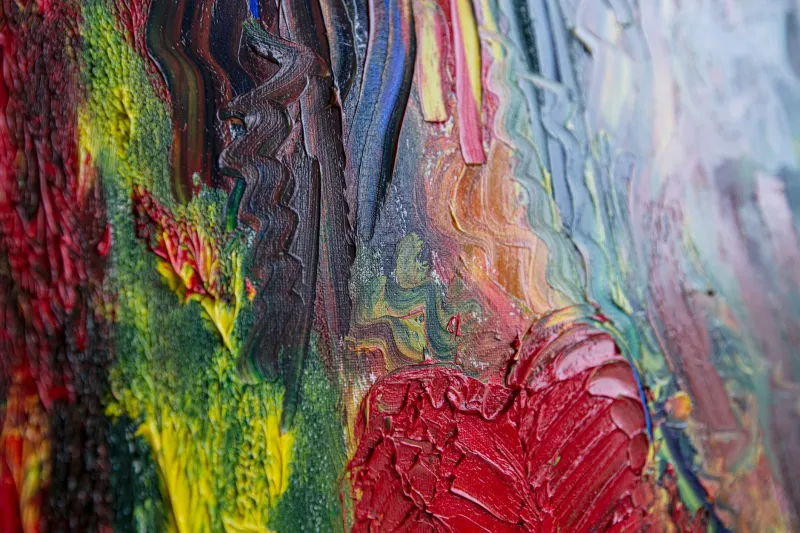
The colours on the floor are not always the colours in the painting. That is the first useful thing to notice. Dried paint flakes often look brighter, chalkier or more acidic than they did wet. A crimson that seemed too loud on the palette can dry into a dull brick on the floor; a green that felt subtle in the mix can sit there like a pea. The floor is not a colour chart. It is a record of testing.
There is also the geography of the mess. Flakes tend to gather where I stand when I’m hesitating. Tape curls collect near the edges of a canvas that has been reworked. Sanding dust drifts towards the skirting board and stays there for weeks, a pale tide line of revisions. If you wanted to reconstruct the making of a painting from the floor alone, you’d get the timing wrong but the mood about right.
Tape and Its Small Betrayals
Masking tape is the studio’s most underrated narrator. A fresh roll promises clean edges; a curled strip on the floor tells you the promise was renegotiated. I use tape to hold a drawing in place, to protect a margin, to test a horizon line. When it comes away, it takes a little paper with it sometimes, or leaves a ghost of adhesive that catches the light.
The curls under the easel are a particular shape: tight at first, then loosening as they dry. They look like quotation marks. I like that. They suggest something was said and then taken back. In painting terms, that might be a horizon shifted by half an inch, a shadow removed, a hare’s ear shortened because the composition didn’t need the extra flourish. The finished work keeps the decision; the tape keeps the hesitation.
Offcuts with Ears
The hare sketches are their own category of debris. I work on scraps of paper when an idea is still forming — a quick ear, a curve of back, the angle of a hind leg. Most of these offcuts end up on the floor or in the bin. A few get pinned to the wall for a week and then join them. The ones that survive are rarely the neatest. They are the ones that solved a problem.
For collectors, this is a useful reminder that a painting is not a single act of inspiration. It is a long conversation with small, stubborn details. The hare that appears in a finished piece may have been rehearsed a dozen times on a scrap no bigger than a bus ticket. The floor knows this even when the wall label doesn’t.
When to Sweep and When to Keep
I am not suggesting anyone turn studio debris into an exhibition. A pile of dried paint is not automatically interesting, and a dusty floor is not a credential. But there is value in pausing before the broom. Once a week, I sort the sweepings into three loose piles: things to bin, things to keep for texture tests, and things that make me ask why I made a certain mark. The third pile is usually tiny. It might be one flake of a colour I miss, or a pencil line I want to remember.
Then I sweep. The studio needs to be workable, not preserved. The point is not to romanticise mess but to notice what the mess is telling me while it’s still there.
What This Means for Collectors
If you visit a working studio — mine or anyone else’s — the floor is part of the tour, whether it’s on the itinerary or not. You don’t need to read it like a forensic scientist. Just notice that the painting above you had a life before it was finished. The revisions, the tests, the abandoned colours: they are not secrets. They are simply the part of the process that doesn’t fit in the frame.
A painting is a decision made visible. The floor beneath the easel is the paperwork. Both belong to the story, even if only one goes home with you.