The Six-Inch View: What a Painting Keeps for the Very Curious
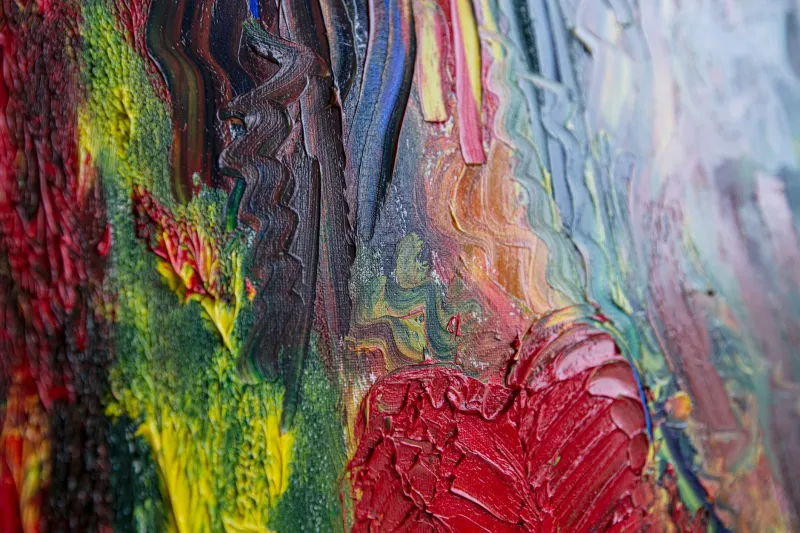
There is a polite distance at which most of us look at paintings. Roughly a metre, maybe a little more, back straight, hands behind the back, the sort of stance that says I am appreciating this in a civilised manner. It is a good distance. It gives you the whole shape of the thing. But it is not the only distance, and it is certainly not the one I spend most of my working life at.
In the studio, I am constantly moving. Three steps back to check the composition. Two steps in to see what a brush actually did. A lean to the left because the light catches a ridge of paint differently from there. The painting has to work at both ends of that little shuttle run. If it only works from the sofa, it is a poster. If it only works from six inches, it is a texture sample. The interesting stuff happens when both views are true at once.
The First Reading and the Second
A painting gives you a first reading from across the room: colour, weight, where your eye lands, whether the hare is sitting still or about to bolt. That is the reading most exhibitions are designed around, and rightly so. You cannot ask a visitor to press their nose to forty canvases in an afternoon. They would be exhausted and possibly asked to leave.
But there is a second reading, and it is quieter. It happens when you get close enough to see that the soft grey-brown of a hare's flank is not one colour at all but a dozen strokes laid over each other, some dry, some loaded, some dragged so thin they barely cover the ground. From a metre away it reads as fur. From six inches away it reads as a series of decisions. I like that. I like that the painting does not give everything up at once.
Hare Fur Is Not Fur Until You Are Close
Hares turn up in my work often enough that people have started to expect them. On a wall, a hare painting does a simple job: it holds a shape, it catches a mood, it makes you look. Up close, the fur is a different animal altogether. I use a small rigger brush for the fine hairs, sometimes over a slightly tacky underpainting so the stroke drags and breaks. I use a dry brush to soften the edge of a haunch. I leave the odd thicker blob where the paint ran out and the bristles splayed.
None of those marks are visible from the other side of a village hall. That is the point. They are not there to be ticked off like a hidden puzzle. They are there because the painting needed them to feel alive at close range, and because a collector will live with the thing. They will walk past it in a corridor every morning. They will see it from the kettle, from the doorway, from the sofa. And one day they will lean in because a bit of light has caught a hair they never noticed before. That moment is worth building for.
Hedgerow Edges and the Useful Accident
Edges are where the close view earns its keep. A hedgerow in a painting is not a wall of green; it is a ragged line of darks and lights, twigs and gaps. From a distance, the eye wants a boundary. Up close, the boundary should break down into scumbles, half-mixed greys and the occasional scraped-back patch where the underpainting shows through.
Some of those marks are deliberate. Some are not. A palette knife can slip, a brush can catch a ridge of half-dry paint, a rag can drag where you meant it to dab. I keep more of these accidents than I used to. They act like punctuation. They stop the close view from feeling too tidy, too managed. A painting that is perfectly controlled at six inches can feel a bit airless, like a show home. I would rather it felt lived in.
The trick is knowing which accidents to keep. A stray knife mark across a hare's eye is a distraction. A stray knife mark along the edge of a field is a bit of weather. That distinction is not scientific. It is just looking, and looking again, and being honest about what the painting is doing.
Building for Two Distances
My working method is not glamorous. I step back a lot. I lean in a lot. I sometimes take a photograph and look at it on a phone screen, because a small image flattens everything and shows you whether the big shapes are holding. Then I put the phone down and go back to the close view, because the phone cannot tell you whether a brushstroke has life in it.
There are practical tensions. Thick paint that looks generous from across the room can look like rubble up close if it is overworked. Fine detail that sings at six inches can disappear into a smudge at three metres. I try to give the distance view strong, simple shapes and the close view enough variation to reward a second look. Broken colour helps. So does leaving a few edges soft and a few edges hard. The painting needs somewhere for the eye to rest and somewhere for it to work.
Inviting the Lean Without the Hover
Galleries have a delicate job here. They want people to look closely, but they also want the work to survive the encounter. The usual solution is a stern little sign and an invigilator who seems to be watching you specifically. That does not invite close looking. It invites you to back away and pretend you were never that interested.
A better approach is choreography. Put a bench near the work, not because anyone needs to sit down, but because it changes the pace. Place the label slightly to the side so a visitor has to step in to read it. Light the painting so the texture catches from an angle. If a gallery wants to say something, say it warmly: please lean in, hands behind your back. That sentence does more than a dozen do-not-touch symbols.
And then leave people alone. Close looking is a private act in a public room. The best invigilation is invisible. A glance, a nod, a willingness to answer a question if asked. Not a shadow. Not a security guard in a cardigan.
What Close Looking Teaches
Collectors sometimes apologise for leaning in when they visit the studio. They seem to think it is a bit rude, like inspecting a host's bookshelf. I always tell them it is the opposite. The close view is the everyday view. It is what you see when you are washing up, or looking for your keys, or standing in the hallway after a long day. A painting has to survive that intimacy.
So I build for it. Hare fur that breaks into individual strokes. Hedgerow edges that come apart into scrapes and scumbles. A palette knife mark that was half accident and half decision. None of it is a secret, exactly. It is just a second reading, waiting for someone curious enough to take a step closer.
Stand back by all means. But do not be afraid to lean in.