The Moulding Makes Its Case: Letting a Painting Audition for a New Edge
There is a particular sound a frame makes when it has had enough. It is not a crack, exactly. It is more of a small, dry cough from the corner joints when you lift the painting down from the wall. I heard it last week on a smaller hare piece that had been in the same oak frame since it left the studio. The painting had not changed. The room had. The frame, once a sensible pair of shoes, now looked like someone else's coat.
That is the odd thing about frames. We treat them as permanent, but they are really a set of decisions made at a particular moment. A frame chosen for a north-facing flat may look sulky in a brighter sitting room. One that suited a painting when it was heading to a group show may feel too formal above a sofa. And sometimes the painting itself simply grows into a different voice. Reframing is not a failure of the first choice. It is maintenance, with a bit of reinvention folded in.
The signs that the frame has stopped serving
The first sign is usually visual: the painting looks smaller than it is. Not physically, obviously. But the frame is taking up too much of the conversation. A wide, ornate moulding can make a modest canvas look like a stamp in a jewellery box. A thin, tired frame can make a rich painting look apologetic. If your eye goes to the corner joints before the colour, the frame is doing too much.
Then there are the practical warnings. Loose corners. Flaking finish. Glass that touches the paint surface. A backing board that has gone brown and brittle. Rust marks near the rebate. Woodworm holes, however decorative they may look. Old nails that have rusted into the frame and are now staining the edge of the canvas. None of these are reasons to panic, but they are reasons to take the painting out and look properly.
I am not in the camp that says every old frame should go. Some frames carry provenance, and some were chosen by the artist for good reasons. A period frame can be part of the work's history. But history is not the same as usefulness. If the frame is damaging the painting, hiding it, or making it hard to live with, it has stopped doing its job.
What a frame is actually doing
Before choosing a new edge, it helps to ask what the frame is for. It is a boundary, certainly. It tells the eye where the painting stops. It can add depth, weight, warmth or coolness. It can protect the surface from knocks and dust, and it can hold the glazing and backing away from the paint. It can also make a small work feel important without making it shout.
The mistake is to treat the frame as decoration first. A frame is a piece of architecture for the painting. It has to sit well with the wall, the light and the room, but it also has to respect the canvas. If the painting is already busy, the frame should be quiet. If the painting is spare, the frame can carry a little more texture. If the work is small, a narrow profile often gives it more presence than a heavy border. If it is large, a slightly deeper edge can stop it feeling like a poster.
The audition, not the makeover
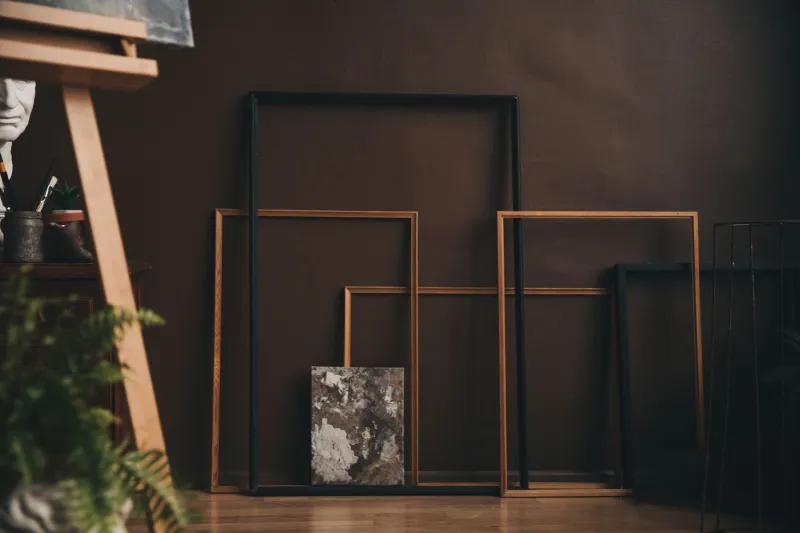
I have started treating reframing as an audition. No sudden decisions. I lean the unframed painting against the wall for a few days and notice what it does. Then I try strips of mount board, offcuts of moulding and paint samples along the edges. I take a photograph. I look at it in the morning and again in the evening. The frame that looks right at noon can look mean under a lamp.
A useful question is: what does the painting need more of? Space, calm, warmth, a little gravity? A pale painting in a pale room may need a darker edge simply to hold its shape. A dark painting may need a lighter frame so it does not become a hole in the wall. And a painting with a lot of movement may need a still, plain edge. The frame should not repeat the painting's argument. It should give it somewhere to stand.
In UK light, which is often soft and changeable, I tend to avoid very shiny finishes unless there is a good reason. A gently waxed wood or a chalky finish will usually settle in better than high gloss. That is not a rule. It is a bias, and biases are allowed in the studio as long as you notice them.
Secondhand moulding, with a measuring tape
Some of the best frames I have used began life around something else. Car boot sales, auction box lots, charity shops, house clearance sales and architectural salvage yards are all worth a slow Saturday. Online marketplaces can be useful too, especially when someone is selling a job lot of old moulding or a frame that has lost its picture. The trick is not to fall for a pretty profile without checking the rebate depth, the overall size and the condition.
Take a tape measure and a small note of your painting's dimensions. Check for warping, splits, woodworm and old repairs. Look at the back as carefully as the front. A frame that has been wet will often show it in the corners. If the finish is flaking, decide whether you are happy to live with that or whether it needs stabilising. Lead-based paint and old finishes are best left to a professional if you are unsure.
A good local framer can cut down a secondhand moulding, re-mitre it and fit conservation materials. That is often the sensible middle path: you get the character of an older edge without asking it to do something it was never built for. It also keeps useful material in circulation, which feels better than buying new every time.
The frames that stayed, and the ones that went
A plain oak frame stayed on a hare painting because it did what a good frame should do: it held the edge without commenting on the joke. A heavy gold frame went, not because gold is bad, but because it made the painting look like it was attending a function it had not been invited to. A thin black frame auditioned for a week and then left quietly. It was too sharp for the soft greys in the work. The painting now sits in a pale waxed ash, and it looks as if it has always been there.
That is the test, really. Not whether the frame is old or new, expensive or found. Whether the painting looks as if it has come home.
The handover
When a frame is ready, I write a short note for the framer: the painting's title, the medium, whether the surface is fragile, and how much space I want between the paint and the glazing. Conservation glazing, acid-free mounts and a proper backing board are not glamorous details, but they are the difference between a frame that protects and a frame that merely surrounds. Keep the old frame if it has history. Label it. Store it flat and dry. A frame can have a second life, but it does not have to have it on the same painting.