When the Room Empties: A Painter’s Notes on the Gallery’s Last Ten Minutes

Photo by Photo by Frolicsome Fairy on Unsplash on Unsplash
Gallery days tend to end without ceremony. The big arrival is at opening: the first footsteps, the first “ooh”, the first person who reads every wall label in order. By late afternoon, the rhythm has changed. Visitors come in twos and threes, then singly. Someone checks the train times. Someone else asks whether the shop is still open. And then, quite suddenly, the room is nearly empty.
Those last ten minutes are not dead time. They are one of the most useful windows in the whole show day — a small, unadvertised viewing slot that rewards anyone who notices it.
The 5.28 Shuffle
In the UK, gallery closing time has a soundtrack. There is the soft clatter of a steward’s keys, the rustle of a coat being retrieved from a bench, the low conference at the front desk about whether the door can be locked yet. In a town-centre gallery, the light outside may already be thinning by mid-afternoon in November. In a village hall show, someone is folding the tea tablecloth while another person asks if the last tray of biscuits should go back to the car.
This is the 5.28 shuffle: the point when the exhibition is still open but the room has already begun to think about tomorrow. Visitors who stay through it are often the ones who came for the art rather than the event. They move more slowly. They stop talking. They look again at the painting they had decided was their favourite, then look at the one next to it.
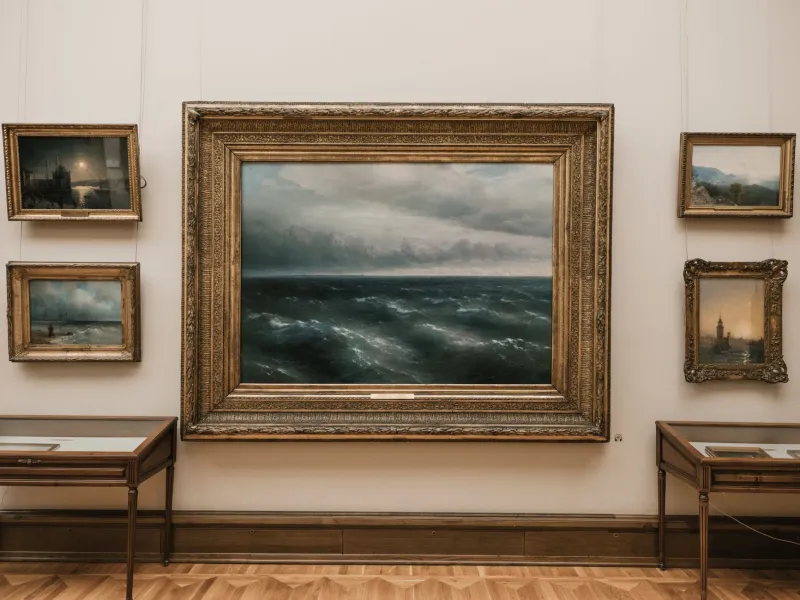
When the room empties, the paintings do not change, but the conditions around them do. The chatter falls away. The door stops opening. The air settles. A canvas that looked busy in a crowd can suddenly seem quieter, or stranger, or more exact. That shift is worth waiting for.
What the Empty Room Changes
A full gallery asks paintings to perform. They become part of a social scene: something to stand beside, gesture at, talk over. An empty gallery asks them to be themselves. You notice different things. The edge of a hare’s ear against a pale ground. The way a grey mixed with a little ochre warms up beside a cooler blue. The place where the brush changed direction, or where a thin scrape of underpainting still shows through.
At Kay Hare Art, we have come to think of this as the room’s second hang. The first hang is the one made with spirit levels, wall plugs and a tape measure. The second happens at the end of the day, when the light is lower and the audience has gone. It is not a physical rearrangement. It is a perceptual one. The show stops being a programme of works and becomes a sequence of single paintings again.
For artists, that can be clarifying. After a day of overheard comments and private-view small talk, the last ten minutes return the work to silence. You can check whether the painting still holds from the doorway, or whether it only worked under the earlier, brighter light. You can see if the label is too low, if the frame is fighting the wall, if the neighbouring piece is pulling attention when it should not. None of this needs a committee. It just needs an empty room and a bit of honesty.
A Different Kind of Invigilation
Invigilators know this window well. The job is often described as watching the art, but in practice it is watching people watch the art. At closing time, that reverses. The people go, and the art is left in charge.
A good invigilator will use those minutes to do a quiet circuit. Not a security patrol, more a slow walk-through: checking that a painting has not been nudged, that a plinth has not drifted, that the temporary label is still flush to the wall. It is also a chance to look properly at the show they have been sitting with all day. Many gallery staff see the work most clearly when they are no longer required to be helpful.
There is a practical lesson here for visitors too. If you are the last person in a room, you are not keeping anyone from their tea. You are using the gallery as it was designed to be used: for looking. The trick is to read the room. If the staff are clearly beginning to close, do not start a twenty-minute conversation about framing. But do take one more turn around the space. The last look is often the one that stays with you.
The Collector’s Quiet Window
For collectors, the closing hour can be unexpectedly useful. The pressure of a private view is gone. You are not competing for a sightline or trying to remember someone’s name. You can stand in front of a painting without feeling that you ought to be moving on.
This is when a work often reveals whether it is a good fit for a home. Not in the abstract, not in a photograph, but in the particular tiredness of a real afternoon. Does the painting give you energy or ask for calm? Is it too quiet for the wall you have in mind, or exactly quiet enough? Those questions are easier to answer when the room is not full of other people’s opinions.
It is also a good moment to ask practical questions. How does the work sit in low light? Does the frame have a slight sheen that might catch a lamp? What is the gallery’s policy on taking a painting away later in the week? Staff are often more relaxed once the day’s footfall has thinned, and the answers are more likely to be useful than rushed.
Lights, Shadows and the Long Walk Back
There is a particular quality to a gallery at the end of the day. The lights are still on, but they seem to be doing a different job. Shadows lengthen under frames. The floor takes on a duller shine. Outside, the high street may be lit by shop windows and bus headlights. Inside, the paintings hold their ground.
This is when you notice scale. A small painting that looked modest in a crowded room can feel remarkably firm on an empty wall. A larger piece that seemed dominant at noon may become gentler as the daylight fades. Neither impression is the “right” one. They are simply different views of the same thing, and both are useful.
The walk back afterwards matters too. Leaving a show in the last of the light gives you time to let it settle. You are not trying to remember everything. You are carrying one or two images home: a colour, a shape, the look of a hare caught at the edge of a field. That is often how a painting earns its place in your memory — not in the noise of the opening, but in the quiet of the close.
Leaving the Show Alone
A gallery’s last ten minutes are not a secret, exactly. They are just easily overlooked. If you find yourself in a show as the day winds down, resist the urge to hurry. Take one final lap. Stand where the invigilator can see you, so nobody has to wonder whether you are planning to move in. Then look at the work as if you had just arrived, not as if you were about to leave.
Paintings spend most of their lives in rooms without crowds. The closing minutes are a small reminder of that. The show is still on, the door is still open, and for a moment the gallery belongs to the work again. That is worth ten minutes of anyone’s day.