The Name After the Paint: How a Canvas Gets Its Title
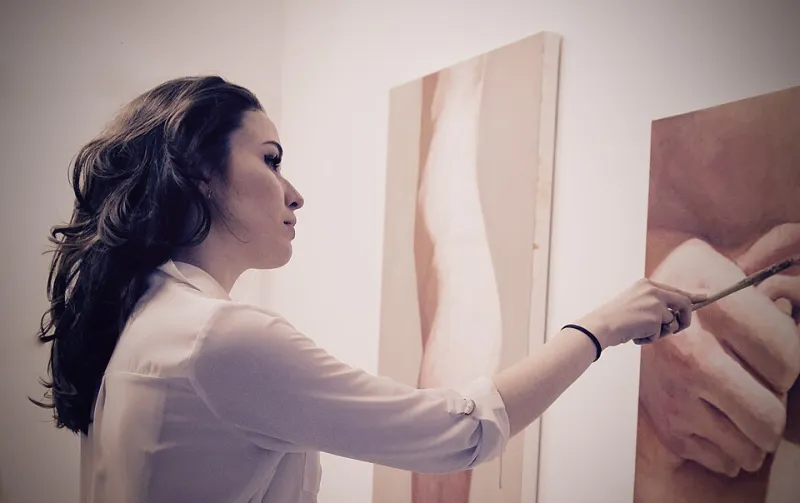
Photo: Officiallyamy, CC BY-SA 4.0, via Wikimedia Commons
There is a moment in the studio when a painting stops being a problem and starts being an object. The edges are dry enough to touch. The last adjustment has been made, or abandoned. The brush is somewhere it shouldn’t be. And then comes the small, awkward question that has nothing to do with paint: what are we going to call it?
Titles are strange things. They arrive late, they change their minds, and they can make a painting feel completely different without a single mark being altered. A good title is not a caption. It is more like a hand on the shoulder — a small gesture that turns you towards the work and then lets go.
The Working Title Is Usually Rubbish
Most paintings in this studio begin with a working title that would never survive a wall label. “The Grey One With the Hare.” “Big Blue Shed.” “That Square Thing.” These are not names so much as coordinates. They exist so I can find the right canvas in a stack and so anyone helping in the studio knows which piece is being discussed. They are practical, ugly and entirely necessary.
Occasionally a working title sticks. A few years ago, a small painting of a hare half-hidden in long grass was called “Field Note” for months because it was pinned above the desk where I keep actual field notes. By the time it was finished, the name had settled into the paint. It was no longer a placeholder. It was the painting.
More often, the working title has to be scraped off. “Big Blue Shed” sounds like a removal firm. “The Grey One With the Hare” tells you exactly what you can already see. A title should not do the looking for you.
What a Title Is For
I used to think a title should explain the painting. Now I think it should do one of three things: open a door, offer a clue, or get out of the way.
A door title invites you in without telling you what to feel. “Low Light, Late Afternoon” is a door. It gives you a time of day and a quality of light, but it leaves the mood alone. A clue title is slightly more mischievous. It points at something you might have missed — a shape in the background, a colour that repeats, a small event at the edge of the canvas. A red herring is not a failure. Sometimes a title that sends a viewer in the wrong direction is more interesting than one that confirms what they already thought.
And then there is the title that gets out of the way. “Untitled” is not a shrug. It is a decision. Some paintings are better off without a name leaning over them. The viewer arrives with nothing but the work and the wall label’s little gap where a name should be. That can be a generous thing to do.
Untitled Is Also a Choice
There is a fashion for treating “Untitled” as a failure of imagination. I don’t buy it. A painting called “Untitled” asks you to look before you read. It removes the shortcut. In a gallery, we are so used to reading a name and then deciding what we think that a blank label can feel almost rude. Good. A little rudeness is useful.
That said, “Untitled” is not a hiding place for every painting that is difficult to name. If a title is avoiding the issue, it usually shows. The work feels unmoored, like a letter without an address. The trick is to know the difference between a painting that wants silence and one that simply hasn’t been asked the right question yet.
Renaming Is Part of the Process
Some paintings get renamed after they leave the studio. A collector will write and say, “We’ve been calling it ‘The Morning One’ — is that all right?” Usually it is. A title is not a contract. It is a handle. If a painting lives in a house where it is known as “The Morning One,” then that is what it is called in that house. The wall label may say something else, but the painting has a second life now.
Other paintings get renamed before they are shown. I had a piece called “Blue Shed” that became “Shed at the Edge of the Field” and then, finally, “A Building That Is Mostly Weather.” The painting hadn’t changed. The title had simply stopped pretending the shed was the subject. The weather was the subject. The shed was just where the weather happened to land.
How to Read a Title as a Collector
If you are looking at a painting and wondering what the title is doing, try this. Read the title once, then look away and look back at the painting. Does the title change what you notice? Does it make you look at a corner you had ignored? Does it make you feel slightly differently about the colour? If yes, the title is working. If it makes you feel like you have been told the answer before being asked the question, it is probably doing too much.
It also helps to read titles slowly. “Hare, Turning” is not the same as “Hare Turning.” The comma is a pause. The pause is part of the painting. A title with a full stop is a different creature from one without. These are small things, but paintings are made of small things.
A Note on the Label
In the end, a title is not the painting. It is the painting’s front door. Some doors are wide open. Some are painted the same colour as the wall. Some have a little sign that says “mind the step.” None of them are the room inside.
So when you see a title on a wall label, treat it as an invitation rather than an instruction. Look at the painting first if you can. Let the name arrive second. And if you find yourself calling it something else entirely once it is home — well, that is how titles really work. They are not fixed. They are just the name we agree to use for now.