Field Notes and Long Ears: The Hare That Keeps Coming Back to My Easel
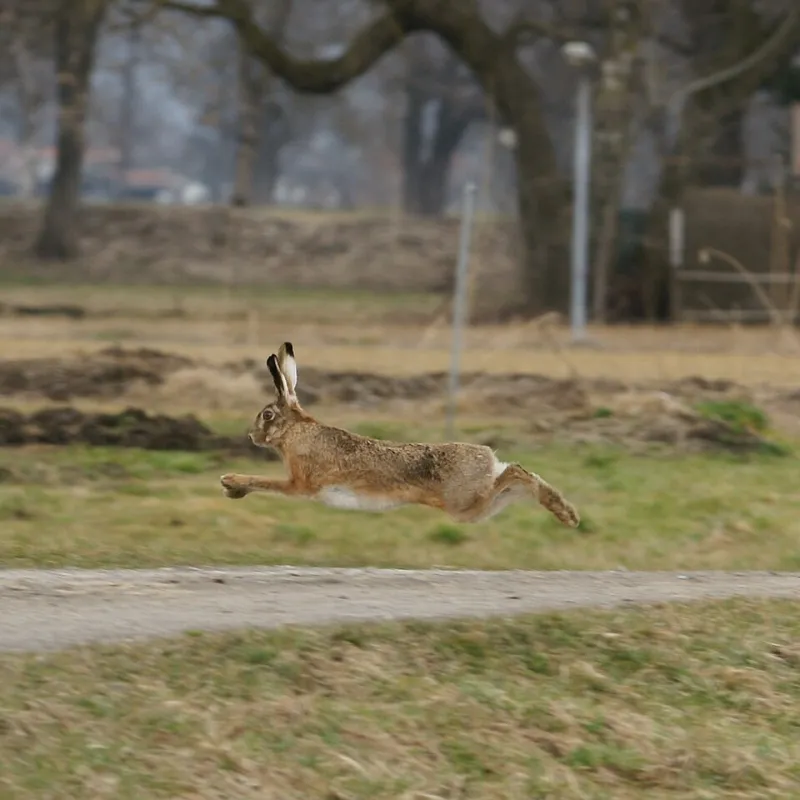
Photo: Böhringer Friedrich, CC BY-SA 2.5, via Wikimedia Commons
There is a page near the back of my current sketchbook that I keep returning to. It is not a clever drawing. It is a hare, caught in about six lines, with one ear too long and a back leg that looks as if it has been added as an afterthought. I made it in a gateway on a cold morning last winter, and it has been quietly insisting on itself ever since.
I did not set out to become a painter of hares. I set out to paint the British countryside as I actually see it: hedgerows that need cutting, fields that are more mud than romance, and the odd creature that looks back at you before it disappears. The hare kept turning up in that looking. Not because it is a mascot, but because it is a subject that refuses to sit still.
A motif with a mind of its own
Motifs are strange things. You do not always choose them. Sometimes they choose you through repetition. I noticed after a few months that the same shape was appearing in the margins of my sketchbooks: a curved back, two upright ears, a suggestion of speed. It was not a plan for a series. It was a habit of attention.
The hare is a good subject for anyone who likes painting things that are half-seen. It is alert, nervous and almost never still for long. That makes it difficult to draw from life, which is part of the appeal. You have to work from fragments: a turn of the head, the angle of an ear, the way the animal seems to fold into the landscape before it runs. The finished painting is not a portrait of a hare. It is a record of trying to hold on to something that has already gone.
What the British landscape does to a hare
Hares have a long history in British art and folklore. They are the mad March hare of old stories, the moon-gazing creature of country superstition, the animal that boxed in the field before anyone had a camera. In painting, they turn up as both observed animal and symbol. Dürer's hare is the famous one, but British artists have long used the hare as a way of talking about alertness, solitude and the edge of the wild.
I am not trying to illustrate folklore. I am trying to paint the moment before the folklore starts. That means paying attention to the ordinary things: the colour of a winter field, the way a hare's coat almost matches the stubble, the pale underside of the tail when it turns. The British countryside is not a backdrop in these paintings. It is the reason the hare looks the way it does.
From field sketch to finished painting
My process usually starts with drawings made outdoors. I work quickly, often in charcoal or pencil, and I do not worry about making them tidy. A field sketch is a note to myself: the set of the ears, the weight of the body, the direction of the movement. I also write small notes in the margin, because memory is unreliable when you are standing in a cold lane with numb fingers.
Back in the studio, the painting takes over. I rarely work from a single photograph. I work from the sketches, from memory and from the feeling of the place. The first layers are often loose and tonal. I am not trying to fill in the hare; I am trying to find the space around it. The negative space matters as much as the animal. A hare in a painting should feel as if it could leave at any moment.
Some paintings come together quickly. Others sit on the wall for weeks while I decide what to leave out. The temptation is always to add more detail, but detail can kill the movement. The final painting is usually the one where the hare is least explained and most present.
What to look for when you look closer
For collectors and gallery visitors, the hare paintings reward a slower look. Start with the ears. They carry the mood of the whole painting: upright and alert, flattened back, or caught mid-turn. Then look at the gaps. The areas of bare canvas or thin paint are not unfinished. They are part of the way the hare sits in the landscape.
Look at the edges too. I often soften the outline where the animal meets the field, because that is how you actually see a hare: not as a cut-out shape, but as something that emerges from the ground. And look at the title. Titles are small doors into the work. A title like 'Winter Gate' or 'Field Before Rain' tells you what I was looking at, without telling you what to see.
The hare keeps returning because it is never fully solved. Each painting is another attempt to catch that alert, ordinary, uncanny creature in the British landscape. I expect it will keep coming back to the easel for a while yet.